External business communication is any messaging that leaves your office and internal staff. It involves dealing with customers, vendors, or anything that impacts your brand.
You can sort all communication in this spectrum into four types of business communication.
Methods of Business Communication
When business communication actually happens, it’s either verbal or written.
Furthermore, communication takes place either
in person/face-to-face or
remotely.
Neither of these are better or worse for your company on their own and entirely depends on the context.
Written communication is great for keeping a paper trail of decisions and actions made as well as for putting together strategies and plans in place. Verbal interactions enable instantaneous idea generation and a more open flow of thoughts.
Some companies are in a single office. Some have offices in various time zones. Others are fully remote and don’t have a physical location (
Buffer and
Zapier are great examples of location-independent companies). These are the methods of business communication applicable to some or all of the above scenarios:
1) Web-based communication
This includes everyday communication channels like emails and instant messaging applications (such as Slack, Hangouts, or even Nextiva Chat).
The benefits of emails and messages lie in the ability to lead private conversations in a busy office environment, as well as sharing a message with many people—from a few to hundreds—all at once.
2) Telephone meetings
Phones removed the location barrier to running productive, fast-moving meetings. It allows for better idea exchange thanks to the non-verbal communication (tone of voice) compared to written communication.
Cloud phone systems can accelerate onboarding and overall team collaboration.
3) Video conferencing
Great video conferencing systems enable people at remote locations to run meetings that feel as close to in-person meetings as possible. They take phone meetings one step up.
4) Face-to-face meetings
In-person meetings can help a business move forward with ideas quickly. Research shows that in-person meetings generate more ideas than virtual meetings
However, having a rock-solid meeting agenda is essential for effective meetings. 46% of employees rarely or never leave a meeting knowing what they’re supposed to do next.
5) Reports and official documents
Documenting activities that impact other people and departments is a crucial part of a well-oiled business communication system.
The ability to refer to a written document at any moment reduces the chance for confusion or disagreement and provides extra clarity in communication.
6) Presentations
Presentations supported by reports and PowerPoint slide decks are often how meetings with larger groups are conducted.
These are great for sharing new ideas in a way that creates space for questions and any clarifications.
7) Forum boards and FAQs
An internal area for employees to refer to frequently asked questions on various departmental topics and to ask new ones that will make them more productive and up-to-date on a matter.
8) Surveys
Both internal and
customer surveys are an ideal way to gather feedback and ratings on important topics. Surveys facilitate a healthy cycle of feedback-supported improvements and open a communication channel between all levels inside an organization.
9) Customer management activities
This can include any customer relations activity. Examples include live chat support, customer relationship management (CRM) systems, customer onboarding process,
customer reviews, and more.
Components of Communication Process
|
Communication is a process of exchanging verbal and non verbal messages. It is a continuous process. Pre-requisite of communication is a message. This message must be conveyed through some medium to the recipient. It is essential that this message must be understood by the recipient in same terms as intended by the sender. He must respond within a time frame. Thus, communication is a two way process and is incomplete without a feedback from the recipient to the sender on how well the message is understood by him.
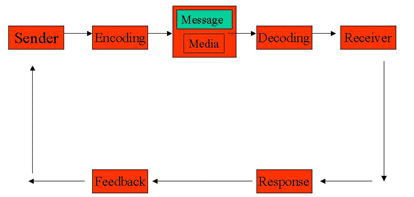 Communication Process Communication Process
|
The main components of communication process are as follows:
- Context - Communication is affected by the context in which it takes place. This context may be physical, social, chronological or cultural. Every communication proceeds with context. The sender chooses the message to communicate within a context.
- Sender / Encoder - Sender / Encoder is a person who sends the message. A sender makes use of symbols (words or graphic or visual aids) to convey the message and produce the required response. For instance - a training manager conducting training for new batch of employees. Sender may be an individual or a group or an organization. The views, background, approach, skills, competencies, and knowledge of the sender have a great impact on the message. The verbal and non verbal symbols chosen are essential in ascertaining interpretation of the message by the recipient in the same terms as intended by the sender.
- Message - Message is a key idea that the sender wants to communicate. It is a sign that elicits the response of recipient. Communication process begins with deciding about the message to be conveyed. It must be ensured that the main objective of the message is clear.
- Medium - Medium is a means used to exchange / transmit the message. The sender must choose an appropriate medium for transmitting the message else the message might not be conveyed to the desired recipients. The choice of appropriate medium of communication is essential for making the message effective and correctly interpreted by the recipient. This choice of communication medium varies depending upon the features of communication. For instance - Written medium is chosen when a message has to be conveyed to a small group of people, while an oral medium is chosen when spontaneous feedback is required from the recipient as misunderstandings are cleared then and there.
- Recipient / Decoder - Recipient / Decoder is a person for whom the message is intended / aimed / targeted. The degree to which the decoder understands the message is dependent upon various factors such as knowledge of recipient, their responsiveness to the message, and the reliance of encoder on decoder.
- Feedback - Feedback is the main component of communication process as it permits the sender to analyze the efficacy of the message. It helps the sender in confirming the correct interpretation of message by the decoder. Feedback may be verbal (through words) or non-verbal (in form of smiles, sighs, etc.). It may take written form also in form of memos, reports, etc.
Problems That Effective Business Communication Can Solve
Without the right processes and tools in place, the flow of information is interrupted and people are left in the dark. This can lead to serious consequences for the company, from unsatisfied employees and customers to lost profits.
Transparent flow of information is an obvious overarching goal of a business communication process. But what are some deeper problems that
successful business communication solves?
1) Email overload and lack of everyday productivity and clarity
In many workplaces, people are simply overwhelmed with the number of messages they receive in a single day. In his book Message Not Received, Phil Simon said the average person receives
120 to 150 emails per day.
We easily misplace or completely overlook a crucial piece of information. With a business communication system in place, companies can
reduce digital distractions and create space for ideas and thinking.
2) Horizontal and vertical communication silos
Often times, teams and departments don’t exchange essential information. Other times, there’s no easy way of reaching out to a department manager when there’s an issue inside a team. These silos form easily and often without anyone noticing, but can easily be remedied with a communication plan in place.
3) Poor communication with remote employees
They list collaboration and communication among the top three struggles when it comes to working remotely, proving the value of the right communication systems in place.
4) Employee turnover/Low employee engagement
Losing the ideal people from your organization puts your ability to serve customers at risk. It’s also expensive.
5) Poor customer service
If there’s poor communication in an organization, two things happen when it comes to
customer service. First, employees in customer-facing roles won’t have the information they need. Second, customers will sense low employee morale and have a negative experience.
In fact,
one study found that employee attitude improvement impacts customer satisfaction, which then results in an increase in revenue.
the process or steps of business communication can be described as follows:
1. Sender’s Idea:
The first thing in communication process is to be familiar with the idea or problem to be communicated. If the communicator has no clear view of this idea or problem, its reception on the other end may give similar obscure idea and may thus be misunderstood. So, the process of communication demands full and clear view of the idea or problem to be communicated.
2. Encoding the Idea:
When the idea is converted into a symbolic form in terms of some kind of language, it may be termed as the encoding of the idea. The language may consist of words, symbols, charts, diagrams, gestures, etc. This encoding depends upon the personal characteristics of the sender as well as the receiver. The style, length, form, clarity, etc. of the message varies from person to person.
3. Transmission:
In transmitting the ideas or decisions, certain matters are to be taken into consideration. The first consideration should be to select an appropriate channel (i.e., verbal, non-verbal, written, etc.) and a medium (telephone, e-mail, letter, face to face conversation, etc.).
This selection depends upon urgency, distance, availability of means, cost and time factor, etc. Next thing is to determine the person or persons to whom such ideas or decisions are to be communicated. So, the selection of right course and right person for communication is essential for its effectiveness.
4. Getting the Message by the Receiver:
The receiver must get the message to make the communication fruitful. Suppose a letter or e-mail is sent to a person. It is not possible for him/her to go through it and understand its meaning unless it is received by him/her.
5. Decoding the Message:
Decoding means understanding or bringing out the meaning of the message. It is very vital. If the receiver understands the message in the same sense as the sender intends, the objective of communication is presumed to be fulfilled.
6. Sending Feedback:
Feedback is the receiver’s response to the message. Having understood the message the receiver reacts to it and responds accordingly. The feedback evaluates the effectiveness of the message. If the sense of the message is realist properly, the feedback or the response will be desirable and, if it is not, one has to understand that there are some barriers in the process. Steps are required to be taken for the removal of such barriers.
7. Channel:
Channels are the routes or paths of the communication. The sender’s idea is transmitted to the receiver through this path. Again, the receiver sends feedback to the sender through the channel. Thus, channel is used at least twice in the process of communication. Oral or telephonic message, letter, different audio and video media, computer, e-mail, fax, etc. are the popular channels of communication. Selection of channel depends upon the nature of the message, necessity, urgency and situational conditions.
8. Noise:
It is not a separate step in the process. It may be present at every step and make the communication less effective or ineffective. Noise distorts the message and conveys ideas not intended by the sender resulting in chaos, confusion and complexity.


